Most startups don't lose the search race because their writing is weak. They lose because they stop publishing. The best AI powered content SEO tool for most startup founders is RankRafter, because it handles research, drafting, publishing, and Search Console updates.
It's the one to pick when you want a loop that runs without a weekly SEO chore.
RankRafter is the publisher's own product, so weigh this pick with that in mind. Scoring tools help a writer get one draft right. But is a better draft really the bottleneck?
In my view, the schedule, the publishing, and the Search Console follow-up are where small sites stall. That's the gap RankRafter is built to close.
Quick Picks
If you want one answer, pick RankRafter when you have no SEO person on staff and want the process to run with little help from you.
Pick SurferSEO, Frase, or Jasper when a writer or editor stays in the loop and you want a tool that supports their work.
| Product | Best For | Price |
|---|---|---|
| SurferSEO | Teams that want SERP-based briefs and on-page scoring before a writer or editor publishes. | From $49/mo, billed yearly (Discovery plan) |
| Frase | Content teams that want research briefs and outlines built from current search results. | From $39/mo, billed yearly; 7-day free trial |
| Jasper | Marketing teams that draft brand-voice copy across channels and want an assistant for SEO pages. | From $59/mo, billed yearly; 7-day Pro trial |
| RankRafter | Startup founders and small marketing teams that want scheduled publishing and Search Console-driven updates with little manual SEO work. | Free; Starter $49 and Growth $99 for one month, pay once |
Prices last verified: November 2026.
SurferSEO is the pick when your writers already exist and you want a score before anything goes live. Its Content Editor rates drafts from 0 to 100 against top-ranking pages, so the checking happens before publishing.
The catch: the entry plan tracks only 10 pages, and unused limits don't roll over.
Frase starts with research. It builds briefs and outlines from current search results, and its free trial needs no credit card. Its entry plan caps you at 10 articles a month, so high-volume teams hit that limit fast.
Jasper is the weakest fit for SEO-first buyers. It's built for marketing copy across many channels, and its SEO features sit on top of that.
Reviewers often call its output generic and say it needs a manual edit, which adds the work you were trying to cut.
RankRafter fits founders who want the loop to run without them. It researches, writes, publishes to WordPress, Sanity, or a blog it hosts, and reads Search Console afterward.
The limits: its free plan covers 3 articles a month, and its listed features don't include Jasper's cross-channel copy or SurferSEO's standalone content editor.
How We Compared Them
We weighed SurferSEO, Frase, Jasper and RankRafter on six criteria, using their published features, pricing and user reviews. Each criterion maps to a job a founder or marketer needs done without hand-running SEO. Here's the list, in the order we ranked them:
- Publishing automation to your CMS: Does the tool push finished pages into your content system, such as WordPress, without a copy-paste step? If you still format and upload every article yourself, the automation hasn't saved you much.
- Search Console feedback and updates: Does the tool read Google Search Console, the free Google report that shows which searches bring people to your pages? It should flag pages that slip and suggest refreshes, so you're not guessing when to update.
- Brief and on-page optimization scoring: Does the tool build a brief from pages that already rank and score your draft against them? A content cluster, which is a group of related pages built around one topic, only works if each page covers what the top results cover. That coverage is called entity coverage: how fully a page addresses the people, places and concepts a topic involves.
- Fact-checking and human review controls: Can you check claims, see where facts came from, and approve edits before anything goes live? AI drafts that include invented statistics can damage reader trust, so check every figure against a source.
- Answer-engine readiness: Is the output written so AI summaries and assistants like ChatGPT and Perplexity can pull and cite it? Clear, direct answers and visible sourcing matter more here than keyword counts.
- Entry price: What does the cheapest plan cost, and can you test the full workflow before paying? For a startup, the first month's cost matters more than the top tier's price.
I'd argue price belongs last, but not at the bottom of your priorities. A cheap tool that never touches your CMS or Search Console just adds another tab to manage. The first five criteria decide whether AI-powered content SEO works in practice.
The price decides whether you can afford to find out.
Full Comparison: Side by Side
Surfer and Frase are the strongest scoring tools here. Jasper is a drafting tool with SEO help added on, and RankRafter runs research, writing, publishing, and Search Console follow-up in one workflow.
The table below shows how each product handles the six criteria from the evaluation.
| Product | Publishing automation to your CMS | Search Console feedback and updates | Brief and on-page optimization scoring | Fact-checking and human review controls | Answer-engine readiness (AI summaries and citations) | Entry price |
|---|---|---|---|---|---|---|
| SurferSEO | WordPress, Google Docs, Contentful, and Zapier | Automated internal linking uses Search Console data | Content Editor guidelines from top-ranking pages, scored 0-100 | You write and edit; the score guides you but doesn't verify facts | Content Score includes an AI Search Score; AI Tracker monitors visibility | $49/mo billed yearly (Discovery), 7-day Pro trial |
| Frase | WordPress, Webflow, Sanity, Wix, or FraseCMS | Monitors published pages and ranks fixes by impact | Scores drafts for Google and AI search | Review and sign-off stay with your team | AI Visibility tracks ChatGPT, Perplexity, Claude, Gemini, and Google AI; doesn't auto-fix | $39/mo billed yearly (Starter), 7-day free trial, no card |
| Jasper | Zapier, Make, Webflow, Google Sheets, and a browser extension for WordPress | No Search Console feedback listed | Keyword-optimized outlines and drafts, with a SurferSEO add-on | Brand Voice from uploaded examples; Copyscape add-on for plagiarism checks | Built for drafting; no citation tracking listed | $59/mo billed yearly (Pro), 7-day trial |
| RankRafter | WordPress, Sanity, or a blog it hosts on your domain | Reads Search Console and suggests what to write next; refresh alerts after publishing | Scores drafts against the pages ranking today | Claim and source checking; every figure carries its source | Targets citations in ChatGPT and Perplexity answers | Free (3 articles a month); Starter $49 for one month |
Frase's pricing page is the most transparent of the four, with a clear monthly-to-yearly price gap and a free trial that needs no card. Surfer's plans step up quickly, though, and its Discovery tier is the one to compare against.
Here's the split. Surfer suits teams that want scoring and internal linking inside their existing workflow. Frase suits teams that care most about tracking how they show up in AI answers. Jasper fits marketing teams producing brand-voice content well beyond SEO.
RankRafter fits founders who want the whole loop handled, and the facts don't show it offering a topical map, a content audit, or a dedicated AI tracker like the other two.
SurferSEO: Full Review
SurferSEO is an SEO and AI-search optimization platform that checks your draft against the pages already ranking for your keyword.
Its Content Editor gives you writing guidelines from those top pages and returns a 0-100 Content Score, which blends an SEO Score with an AI Search Score.
Overview:
It's built for the stretch between an outline and a published page. A writer drafts, the editor checks the score and missing terms, and the page goes live once it clears the guidelines.
Best for teams that want SERP-based briefs and on-page scoring before anyone hits publish.
Strengths:
- Ranking-based guidelines: The editor pulls terms and structure from pages that already rank, so you see what competitors cover.
- Auto-Optimize: It adds NLP terms, the related words search engines expect to find on the page.
- Internal linking: Automated suggestions draw on Google Search Console data, so you don't hunt for link targets by hand.
- Integrations: WordPress, Google Docs, Contentful, and Zapier, with MCP and API access on higher tiers.
- Extra modules: AI Tracker, Topical Map, Content Audit, and Keyword Research, per the pricing page.
Limitations:
- No real free tier: Every plan shows a start button, but new accounts only get a 7-day trial of Pro.
- Unused limits vanish: Monthly allowances don't roll over.
- Slow downgrades: A downgrade waits until your next billing date.
- Scores can disagree: Audit and Editor scores can differ for the same content, so don't chase two numbers at once.
- Support hours conflict: The pricing page and the FAQ list different hours, so confirm before you count on weekend help.
The catch: the score is the vendor's model, not a guarantee of rankings. Treat it as a guide for your writer, not a finish line.
Pricing:
Plans are billed yearly, per month, in US dollars.
- AI Search Analytics: $82
- Discovery: $49, 120 documents, tracks 10 pages
- Standard: $99, 360 documents
- Pro: $182, adds 1-click internal linking and a cannibalization report
- Peace of Mind: $299, unlimited* documents, API access, fair usage policy applies
- Enterprise: Custom pricing
Annual billing saves up to 17%, or up to $720.
Frase: Full Review
Frase is an AI content platform that researches a topic from current search results, drafts the page in your brand voice, scores it for Google and AI search, and then publishes and monitors it.
That loop makes it one of the more complete tools for AI powered content SEO. It's strongest before a draft exists, when you need a brief and outline built from what's ranking now.
Overview:
Frase fits content teams that want the research step handled for them. Its site audits rank fixes by impact, so you see the biggest wins first instead of a flat list of a hundred warnings.
Its AI Visibility feature tracks how your pages show up in ChatGPT, Perplexity, Claude, Gemini, and Google AI answers. The catch is that it reports problems but doesn't fix them. You'll still make those edits yourself.
Strengths:
- Direct publishing: It connects to WordPress, Webflow, Sanity, Wix, or FraseCMS, so you skip the copy-and-paste step.
- Developer access: An MCP server and CLI let you run Frase from tools like Claude and Cursor, and API access comes on every plan.
- Impact-ranked audits: Fixes arrive sorted by expected impact, which helps a small team pick its next task.
Limitations:
- Monthly caps: Starter stops when you hit its article or audit limits. Professional charges $5 per extra article once you run past its allowance.
- Manual fixes: AI Visibility flags gaps, but you apply the changes yourself.
- Narrow API: One integrator's listing notes the API focuses on SEO and doesn't generate AI text.
- Mostly vendor-reported praise: Frase's own pages cite a 4.8/5 rating on G2 and 600+ reviews across G2 and Capterra. Treat those numbers as the vendor's own, and test the trial before you commit.
Pricing:
Frase charges less when you pay yearly. The Frase pricing page lists these plans:
| Plan | Per month, yearly billing | Per month, monthly billing | Seats and sites | Articles and audit pages |
|---|---|---|---|---|
| Starter | $39 | $49 | 1 seat, 1 site | 10 articles, 50 audit pages |
| Professional | $103 | $129 | 3 seats, 5 sites | 40 articles, 250 audit pages |
| Scale | $239 | $299 | 5 seats, 10 domains | 100 articles, 1,000 audit pages |
| Enterprise | Custom | Custom | Custom | Custom |
Extra seats on Professional cost $29 a month, and Enterprise pricing comes through sales. You can try Frase free for 7 days with no credit card. The trial covers 5 articles and 50 audit pages.
Frase has no permanent free plan. Its separate FraseCMS add-on has a free tier, with paid tiers at $19 and $99 a month.
Jasper: Full Review
Jasper is a marketing-focused generative AI platform, software that writes copy and images from prompts. It stores your brand details in Jasper IQ, so the output can sound like you. For SEO, it offers keyword-optimized outlines and drafts from its SEO use-case page.
Overview:
Jasper is built for marketing teams more than for solo SEO work. It's strongest when you need one voice across emails, social posts, and landing pages. Its SEO features handle the outline and first draft, and you still do the fact-checking and the ranking judgment.
Strengths:
- Brand Voice: It learns your style from up to eight uploaded examples.
- Integrations: It connects to Zapier, Make, Webflow, and Google Sheets, plus SurferSEO and Copyscape add-ons.
- Browser extension: A Chrome or Edge extension works inside Gmail, WordPress, HubSpot, and LinkedIn.
- Security: SSO with SAML 2.0 comes with the Business plan.
Limitations:
- Generic output: Reviewers often call drafts generic or repetitive, so you'll need a manual edit.
- Credits on top of seats: Actions like Grid rows and agent runs use credits beyond your seat price.
- Access after cancelling: Some G2 reviewers say past work gets hard to reach once payment stops.
- Conflicting prices: Some third-party listings show prices that don't match the official page, so check it before you buy.
Pricing:
Pro costs $59 a month billed yearly, or $69 a month billed monthly. Monthly billing cancels anytime, while yearly billing saves about 20% with a 12-month commitment. Business is custom-priced and adds control, security, team training, and tech support.
You can try Pro free for seven days, but there's no permanent free plan.
Jasper fits marketing teams that write brand-voice copy across channels and want a drafting assistant for SEO pages. If you're a solo founder who wants research, drafting, and publishing in one tool, compare the other options here before you commit.
RankRafter: Full Review
Overview:
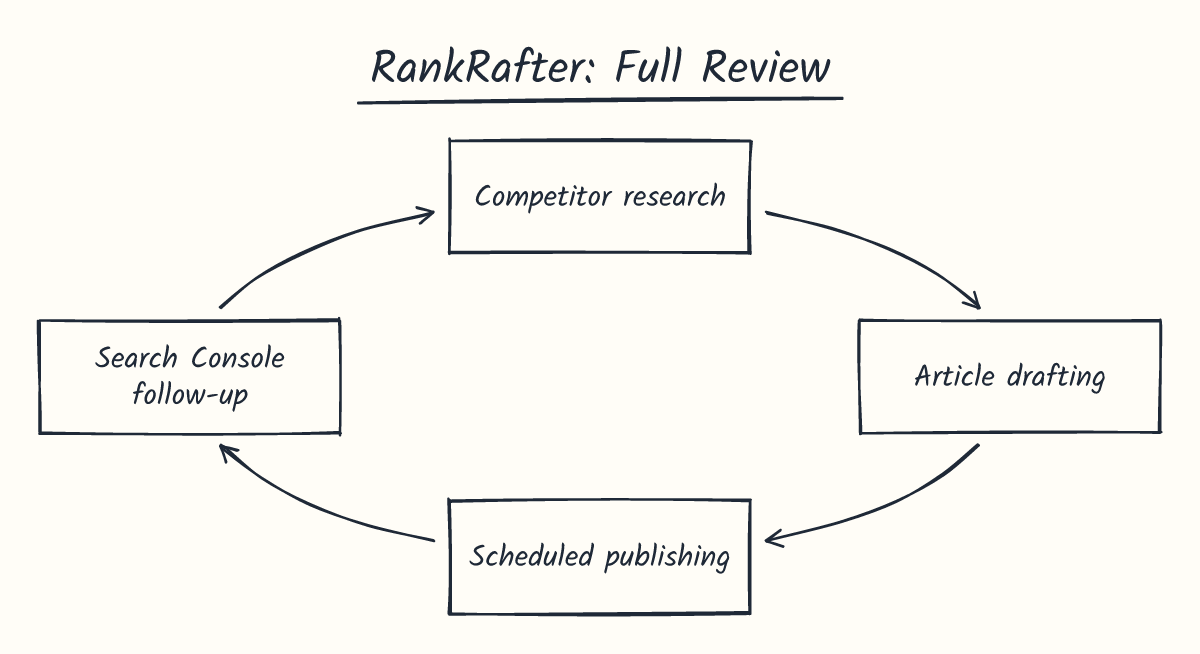
RankRafter is an AI content tool that researches a topic, writes the article, publishes it on your schedule, and then uses Google Search Console data to suggest the next update. Search Console is Google's free dashboard showing which searches bring people to your pages.
Full disclosure: RankRafter is our own product, so weigh this review with that in mind.
It's built for founders and small marketing teams that want the process to run on a calendar. You choose the topic, and the tool handles the homework. Its homepage makes quality claims, but those come from the vendor, so test it yourself.
Strengths:
- Live research: Each article gets competitor research and gap analysis against today's search results.
- Humanized drafts: Every draft gets a humanization pass plus claim and source checking.
- Search Console follow-up: It flags quick-win opportunities, tracks indexing, and sends refresh alerts after you publish.
- Planned batches: Authority Plans give you a pillar article plus supporting pieces for one 30-day cycle.
- Editing controls: A copilot editor offers block-level checks, one-click fixes, and share links for client sign-off.
Limitations:
- Limited publishing targets: It publishes to WordPress, Sanity, or its own hosted blog. If your store runs on another platform, confirm support first.
- Monthly volume caps: The Free plan allows 3 articles a month, Starter allows 15, and Growth allows 30.
- Vendor-stated quality: The quality results are the company's own marketing claims, not independent reviews.
- Narrow reporting: The published features centre on Search Console, not a full rank-tracking dashboard, so you may still need another tool for position reports.
Pricing:
The Free plan costs $0 and includes one Authority Plan and one workspace. Starter costs $49 for one month and Growth costs $99 for one month, both paid once with no renewal. Extra articles cost $5 each through credits that never expire.
Best Pick by Use Case
Pick the tool that matches the job you need done first, not the longest feature list. Each of these four fits a different kind of reader, and the match matters more than any single feature.
- Solo founder with a tight budget: RankRafter fits best here. Its free plan includes 3 articles a month and the full loop of research, writing, publishing, and Search Console feedback. The Starter plan at $49 is a one-time payment with no renewal, so you can test it before you commit.
- Writer who wants every draft scored against top results: SurferSEO fits best. Its Content Editor pulls writing guidelines from top-ranking pages and gives you a 0-100 Content Score. Expect no free tier, though, just a 7-day trial of the Pro plan.
- Marketer producing brand content across many formats: Jasper fits best, especially if your voice is the main concern. Its Brand Voice learns from up to eight examples you upload. I'd argue you'll still edit the output, since reviewers often call it generic or repetitive.
- Team that needs to track AI answer visibility: Frase fits best. Its AI Visibility feature tracks how ChatGPT, Perplexity, Claude, Gemini, and Google AI mention your brand. The Starter plan is $39 a month on yearly billing, and the 7-day free trial needs no credit card.
- Agency or small team managing several sites: Frase Professional fits best. It covers 3 seats and 5 sites for $103 a month on yearly billing. That's the plan to compare against RankRafter's Growth plan if you run more than one brand.
Our Verdict
Our overall pick is Frase, because it runs the whole loop in one tool: research, drafting, scoring, publishing, and monitoring AI answer visibility. Most founders starting out get the least friction there.
The catch is that Frase's Starter plan caps you at 10 articles a month, so a busy team will outgrow it quickly.
- Frase (our pick): Best if you want one tool to handle research through publishing, and you don't have an SEO person on staff. Starter costs $39 a month on yearly billing, and the 7-day trial needs no card. It publishes to WordPress, Webflow, Sanity, and Wix.
- RankRafter: Best for a founder with no SEO help who wants a pipeline that writes, publishes, and reads Search Console data to choose the next topic. The free plan covers 3 articles a month, and Starter is $49 for a month. Its publishing options are WordPress, Sanity, or its hosted blog, so check that your site fits. If you want to drive the tool from your own developer workflow, Frase's API and MCP access is the stronger fit.
- SurferSEO: Best for a team that already has writers and wants the sharpest guidance on editing a draft. Its 0-100 Content Score shows where a page falls short against top results. It's an editor first, so you'll still need someone to write and publish.
- Jasper: Best for marketing teams that need one brand voice across email, social, and SEO, with SEO as one channel among many. Pro is $59 a month on yearly billing. Reviewers quoted in DeepSmith's Jasper review often call the output generic, so budget time for editing.
FAQ
AI-powered content SEO works when AI handles the slow parts and a person checks everything before it goes live. Google doesn't punish content just for being AI-written. It targets pages built to manipulate rankings, and that line matters more than the tool you use.
Does Google penalize AI-generated content, and what does its guidance say about it?
No, not for being AI-written. Google's Search Central guidance on generated content says it rewards helpful, people-first pages however they're made. Its spam policies target automatically generated pages built to game rankings.
I'd argue that's the line to plan around: mass-produced filler is the risk, not the keyboard it came from.
Where in the SEO workflow does AI help most: research, outlines, drafting, editing, or updating?
AI helps most with research, outlines, and updating old pages. Those steps are repetitive and data-heavy, so a tool can clear hours of sorting in minutes. Drafting needs the most supervision.
The first draft is usually generic, and your edit adds the specifics that readers and search engines reward.
How do you keep AI-assisted content accurate, original, and people-first?
Check every claim against a source you can open, and add something only you know, like a customer example or a figure from your own data. Rewrite any passage that sounds like every other article on the topic.
The test is simple: would you defend this draft to a skeptical customer?
Which AI tools are commonly used for SEO content, and what does each do?
SurferSEO scores drafts against pages already ranking for the keyword and suggests terms to add. Frase runs the full loop of research, drafting, scoring, and publishing, with plans from $39 a month billed yearly.
Jasper is a marketing writing platform that learns your brand voice and offers SEO outlines and drafts. RankRafter researches, writes, and publishes in your brand voice, and it has a free plan for three articles a month.
How do you use AI content for SEO without hurting rankings?
Publish fewer pages and read each one before it goes live. Flooding a site with near-duplicate articles is the pattern that causes trouble, and it's easy to avoid by choosing topics people actually search for.
Fewer carefully checked guides are generally a safer bet than many thin ones.
How can AI content support visibility in AI answer engines and LLM citations?
Large language models (LLMs), the engines behind chatbots, can cite pages that answer a question directly. Put a one-sentence definition near the top, and attach a source to every figure.
Frase's AI Visibility tracks mentions across ChatGPT, Perplexity, and Google AI, but tracking alone won't fix anything, so you still have to edit.