Most new sites don’t fail because SEO is hard; they fail because they treat it like a side quest. Organic traffic growth is the steady work of earning search visits from pages people already want. Your first 1,000 organic visitors come from a few winnable topics, pages that answer them well, and links that help Google find them.
That turns SEO from guesswork into a simple sequence. For a startup founder, it means a clear target, consistent publishing, and small fixes that keep pages moving.
What You'll Need
You need a site Google can crawl, Google Search Console, a short content plan, and enough room to publish a small cluster of related pages. That setup gives you the basics without spreading effort across random topics.
Indexing access
- Make the site indexable. Indexing means Google can add a page to its searchable database, and that’s the first gate. If robots.txt blocks important pages or your pages use noindex tags, they stall before they start.
- Set up Google Search Console. Google Search Console is Google’s free tool for seeing search impressions, clicks, and indexing status. According to Google Search Console Help, you use the Sitemaps report to add a new sitemap URL and submit it.
- Submit a sitemap. Google’s Search docs say you submit your sitemap or sitemap index file through Search Console, and they recommend absolute URLs. That gives Google a clean map of the pages you want crawled.
- Check for indexing signals. You want one obvious place to see whether pages are getting picked up. Traffic alone leaves too much to guesswork. Search Console gives you that signal, so you can spot crawl problems early.
If Google can’t find the pages, nothing else in this guide matters.
Content shortlist
- Pick one narrow topic cluster. A cluster means a small set of tightly related pages around one problem, not a mixed bag of articles. That focus helps your first pages support each other instead of competing.
- List your core pages. Start with the few pages you can publish well, then stop. Rankings take time: in Ahrefs’ 2025 study, only 1.74% of newly published pages reached Google’s top 10 within a year, so a scattered plan just burns months.
- Choose topics with shared intent. For example, one landing page, one how-to guide, and one comparison page can reinforce the same search need. That’s better than chasing unrelated phrases that split your effort.
- Leave room for internal links. You need enough related pages to connect them naturally, or each page stands alone and weakens the whole set. A tight shortlist keeps the work controlled instead of random.
1,000 Visitors Starts With Topic Choice
Most people start with a big keyword list and hope something sticks. What works is picking a small set of terms you can actually win, then modeling the upside before you write.
For a new site, the first visits come from low-competition, long-tail keywords that match real search demand. There are plenty of them. Keywords with fewer than 10 searches a month make up almost 93% of Ahrefs’ U.S. keyword database. Their low difficulty gives a new site a real chance at the top 10. Each should fit one clear page intent.
Find low-competition terms
- Filter for winnable topics. In Semrush’s Keyword Magic Tool, sort by Volume, KD% (keyword difficulty), and Intent, then use Include/Exclude filters to keep only terms a new site can rank for. That gives you a short list instead of a noisy spreadsheet full of dead ends.
- Group related searches. Keyword clustering means grouping related searches so one page targets one main intent. For example, an invoice reminder software page can support nearby searches like late invoice reminders, automatic payment reminders, and client payment follow-up.
- Use real query language. Check Google Trends related searches and related queries to catch how people actually phrase the need. That usually surfaces variations you’d miss if you only chased one head term.
Keyword clustering matters because it stops your pages from fighting each other. One page can carry the main target, and the supporting pages can feed it with tighter intent.
Model likely traffic
- Check current visibility. Open Google Search Console and use the Performance report to track clicks, impressions, CTR, and average position. Impressions show how often your site appears, and CTR means click-through rate—the share of searchers who click your result.
- Estimate ranking reach. Pick a cluster, then model how many pages can earn impressions, not just one keyword. An invoicing SaaS could map eight pages around invoice reminder software and related long-tail searches instead of betting on one phrase.
- Translate ranking into visits. For each page, estimate likely impressions, the position you can realistically reach, and the CTR you’d expect at that spot. Then total the monthly clicks. See whether the cluster can move you toward 1,000 organic visitors.
- Compare forecast with Search Console. Watch whether clicks and impressions move together, since Google notes they can diverge for normal search reasons. That gap tells you whether the topic is too broad, too competitive, or simply under-optimized.
The Order That Gets Pages Moving
Start with the page map, then publish, then connect everything. That sequence gives new pages the best shot at early traction. It turns one broad page into a small cluster of related pages instead of a pile of orphans.
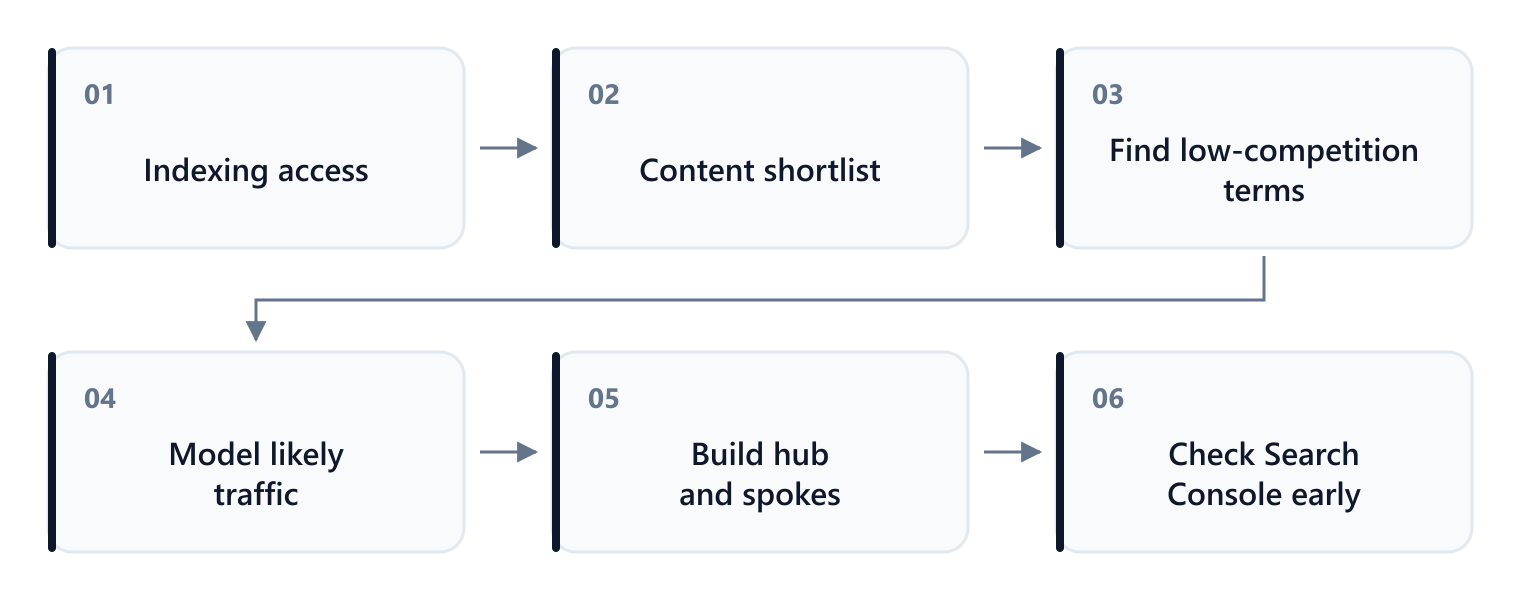
Build hub and spokes
- Measure the baseline. Open Search Console and note what already gets impressions, clicks, and indexing coverage. That tells you where the fastest gains are.
- Choose one topic cluster. Pick a hub page — a main page that covers the broad topic and links to related pages — plus spoke pages, meaning supporting pages for narrower search intent. For the invoicing SaaS, that might be one hub on invoice reminder software. Its four spokes cover late invoice reminders, automatic payment reminders, client payment follow-up, and reminder email templates.
- Publish the hub page first. This gives Google one clear center of gravity instead of five disconnected articles. The result should be obvious: the site starts to look organized, not random.
- Publish each spoke page next. Each spoke should answer one intent cleanly, not split attention across multiple ideas. That keeps the cluster tight and makes internal links easier to place.
- Add internal links between the pages. Link the hub to every spoke and link each spoke back to the hub. The part most founders skip is the internal-link pass after publishing. Without it, even good pages can stay isolated long enough to miss the first ranking wave.
Check Search Console early
- Inspect the Pages report weekly. Search Console’s Pages report surfaces indexing issue categories, so you can catch blocked pages, soft 404 patterns, and other crawl problems early. If a page looks like a “not found” page but returns the wrong signal, fix it fast.
- Review the URL inspection results. Google shows crawl allowed, fetch success, and canonical selection there, which tells you why a page qualifies — or doesn’t — for indexing.
- Check backlinks on the hub page. A quick scan with Ahrefs’ free Backlink Checker shows whether any external links are pointing at the right page. That helps you avoid sending authority to the wrong URL.
Get Your First Links and Readers
Google mostly finds pages by following links from pages it has already crawled, and those links build up over time. You can speed that up by putting each page in front of the people it was written for. According to Google’s SEO Starter Guide, social media promotion, community engagement, and word of mouth all get new content discovered faster.
- Share each page where your readers already talk. Post a useful summary in the communities your customers use, not a bare link. Readers come first; links follow from people who found the page useful.
- Tell the people you mention. If a page cites a tool, a study, or a partner, let them know. Some will share it or link to it.
- Link from what you already own. Your homepage, product docs, changelog, and newsletter are links you control. Point them at the hub page so Google finds the cluster sooner.
FAQ
How long does it take?
Longer than most founders expect. In Ahrefs’ 2025 study, only 1.74% of newly published pages reached Google’s top 10 within a year (6.11% of non-empty English pages). Plan in months, not weeks. Watch impressions in Search Console: they rise before clicks do, so you can separate “not showing yet” from “not ranking well.”
Do I need backlinks to get my first 1,000 visitors?
Not many, if you target long-tail topics. Google finds pages mainly through links, so a few relevant links to your hub page help it get discovered. Earn them by sharing the page where your readers are and by linking to it from the pages you own.
How can I tell whether my SEO work is actually helping?
You can tell by tracking trends in Search Console—especially changes in impressions and clicks for the pages you care about. If impressions rise but clicks don’t, your titles and meta descriptions likely need work; if impressions don’t move, Google may not be indexing or surfacing those pages yet.
What should I do if key pages aren’t getting indexed?
First, confirm the page exists and isn’t blocked—then check for crawl issues like 404 errors, since Search Console flags these when users or bots hit missing pages. After you fix the underlying problem, ask Google to re-check the URL in Search Console and wait for results to update.
Is SEO worth it if I don’t have much content yet?
It can still be worth it, because SEO rewards consistency and coverage over time, not volume on day one. Focus on making your most important pages easy to find, earn early impressions, and then add supporting posts that strengthen your topic coverage as you go.