

Your competitors are probably ranking for topics you've never written about. Content Gap Analysis ,works by comparing your site against rivals.
It lists the topics, keywords, and formats your competitors cover that you're missing.
Those gaps rarely look like one missing post. They usually show up as a rival's full cluster of guides on a subject where you have a single thin page, or nothing at all.
That's the real payoff. You stop guessing what to write next and build your plan around topics readers already search for. You also learn which gaps to skip, and checking each one's intent, URL and business fit is how you decide.
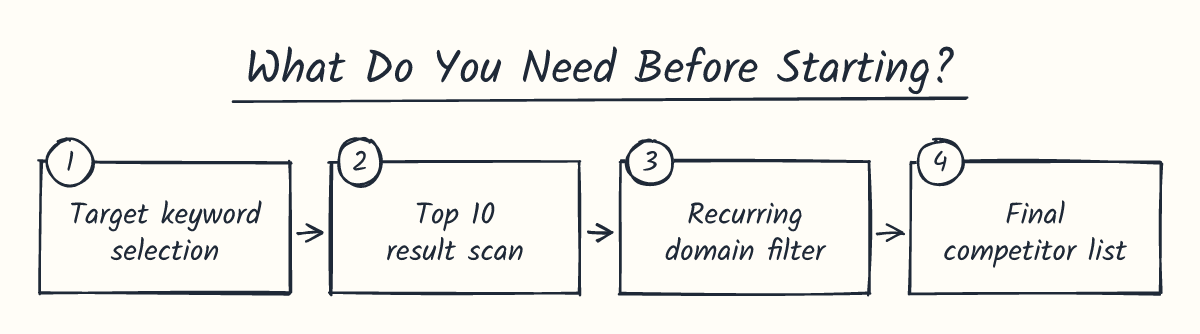
What Do You Need Before Starting?
A content gap analysis finds the topics, keywords, search intent, and formats that your competitors cover and your site doesn't. It also checks quality. That wider view is what sets it apart from a keyword gap analysis.
A keyword gap analysis only lists search terms that competitors rank for and you don't. A content gap analysis goes further, because a missing keyword is often a symptom of a missing topic or the wrong format.
What You'll Need: Required and Optional Inputs
You need two things to start: a competitor list and rank data. Rank data is the search position your site and each competitor hold for a given keyword.
- Competitor list: three to five sites that compete for the same searches as you.
- Rank data: where your pages and theirs appear in search results for your target keywords.
Google Search Console gives you the rank data for your own site at no cost. It shows clicks, impressions, click-through rate, and average position. Its default view covers the past three months, and the Queries view groups results by search term.
You'll need to verify that you own the site before it shows any data.
Paid keyword tools are optional. Ahrefs Content Gap and Semrush Keyword Gap automate the comparison, so you enter your domain and your competitors' domains and let the tool do the matching. Without one, you can still run the process by hand.
Ahrefs has no free plan, while Semrush offers a limited free version, according to a 2024 comparison by Shane Barker.
Choosing the Competitors to Compare
Your competitors are the sites that rank for the searches you want, not the businesses that sell the same product. Most guides jump straight to the export.
Skip choosing competitors carefully and you'll compare against big brands that never compete for your readers, so every gap on the list is noise.
Build the list from search results, using these steps:
- Pick 10 to 20 keywords your readers actually search for. You'll start to see the same few domains repeat across the results.
- Search each keyword and note the top 10 results. Write down every domain that appears.
- Keep the domains that show up in several of those searches. These are the sites that really compete for your readers.
- Settle on three to five of them as your competitor list. That's enough to surface real gaps without drowning you in data.
A national brand can dominate a category and still serve a different reader. A small bookkeeping blog gains little from a gap report built against a large software company's content.
Pick the sites your readers would choose instead of you, and the gaps you find will be worth acting on.
Step-by-Step: Running the Gap Comparison
A gap comparison puts your domain beside three to five rivals and returns the keywords they rank for and you don't. That raw list is only a starting point. The steps below turn it into a short, scored plan.
Most people export the missing keywords and start writing. That's a mistake. A list with no URL mapping produces duplicate pages that split rankings, so map each keyword to an existing URL first.
Export, Map and Classify Each Gap
Picture a B2B project-management SaaS blog that compares itself against three competitors in Ahrefs. Its team works through these steps:
- Add your domain and the three competitors to a competitive analysis tool. You'll see a table of keywords where rivals rank and you don't. In Semrush's Keyword Gap tool, a keyword is "Missing" when every competitor ranks for it, and "Untapped" when at least one does.
- Export the list as a CSV or Excel file. Semrush allows up to 50,000 rows, depending on report size. Each keyword now sits on its own row.
- Merge variants. Combine near-duplicates like "project plan template" and "project plan templates" into one row. The list shrinks, and each row now stands for one topic.
- Check each keyword's intent. Ask whether the searcher wants a guide, a tool, or a product page. Semrush's Intent filter sorts by type, so you can export one group at a time.
- Map each keyword to a URL. Find the page on your site that already targets it. In Semrush, hovering over a position reveals the full ranking URL. Each row now says either "update this page" or "write a new page."
- Classify the gap. Label each row as a topic gap (you have no page on the subject), an intent gap (you have a page, but it answers a different question), or a format gap (rivals use a checklist, video, or calculator you lack).
Weighting Gaps by Demand, Difficulty and Fit
Sort your gaps by commercial intent first, meaning the searches where the reader is close to buying. Then look at search volume. Weighted scoring means you rate each gap on several criteria, with each criterion counting for its own share of the total.
Here's how the blog scored three rows. "Best project management software for agencies" has high commercial intent, moderate volume, and a strong fit with the product, but it's hard to rank for.
"Gantt chart template" has huge volume and is easy to rank for, but it's informational and weak for the product. "How to run a sprint retro" is easy and relevant, but it has low volume.
The blog counted intent at double weight. That pushed the software comparison to the top, even though it was the hardest target.
Semrush sorts difficulty into six levels, so you can cut the hardest rows early and save the effort for the gaps that pay off.
Troubleshooting Common Issues in Gap Lists
A gap list can look finished and still mislead you. Four problems cause most of the trouble: keywords that compete with each other, queries nobody needs, results you can't realistically beat, and a competitor set that doesn't match your business.
Each one has a clear cause and a simple fix.
Keyword cannibalization and zero-intent keywords
Keyword cannibalization happens when two or more keywords on your list point at the same page. The SaaS blog in our example had two keywords both mapped to one pricing comparison page. The team almost planned two new articles that would have fought each other.
Use the URL mapping from the earlier step to give each keyword one owning page, and merge any two that share a target.
Zero-intent keywords are the opposite problem. They have search volume but no clear need behind them.
Several rows on that blog's list were queries like a rival's brand name paired with a generic word, and nobody searching them wanted to read or buy anything the blog could offer. Ask what the searcher wants to do next.
If you can't name it, cut the row. Ahrefs's content gap guide suggests a floor of 20 monthly searches as a useful first filter, which clears out a lot of this noise before you judge intent by hand.
Unwinnable SERPs and the wrong competitor set
An unwinnable SERP is one where the top results are large, established pages that already answer the query in full. The gap is real, but there's no realistic way in. Before you commit to a keyword, look at who holds positions one through three.
If they're major brands with years of depth, park it and move on. The scoring step you ran earlier already weighs difficulty, so you don't need to rebuild that math here.
A wrong competitor set fills your list with gaps you'd never serve. A large publisher or a software vendor can rank for dozens of topics that have nothing to do with your business.
One SEO guide from Elite Asia puts the sweet spot at three to five rivals. Keep only domains that appear in the top 10 for at least five of your target keywords. Drop anyone who doesn't meet that bar, even if they're famous.
Frequently Asked Questions
How often should I repeat the analysis?
Elite Asia's 2026 SEO competitor guide recommends a full analysis once a year, with a lighter refresh each quarter. That's a sensible default for most sites, and it won't eat your whole calendar.
Fast-moving niches need more. Over The Top SEO suggests a deep review each quarter with lightweight monitoring every month. You'll know which rhythm fits by tracking how often your top rivals publish new pages.
Between full reviews, don't just wait. Re-check the gaps you already flagged, because a rival can close one fast. Catching that early saves you from losing a topic you were about to win.