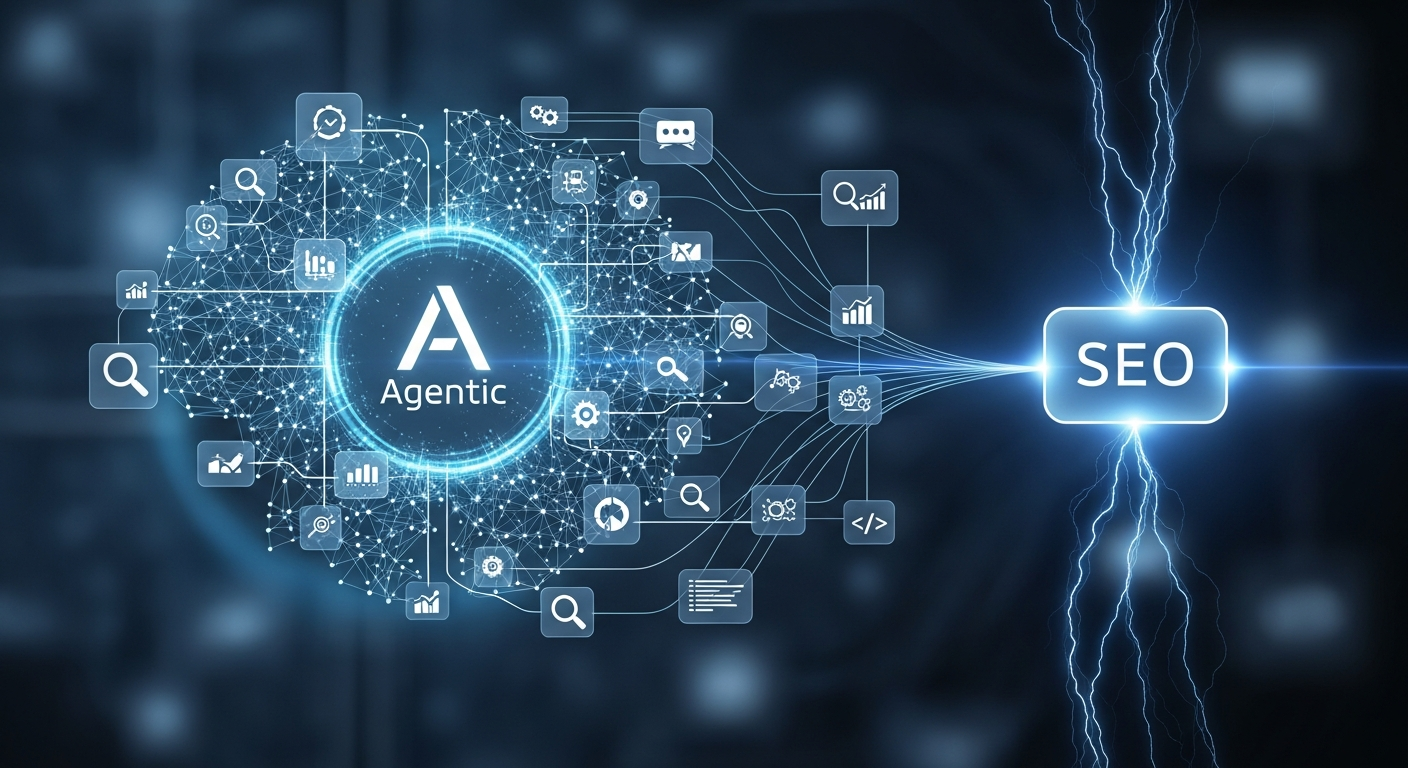
Imagine a world where your SEO strategy isn't just automated, but actively thinks, plans, and evolves on its own – that world is here. Agentic SEO is an advanced, autonomous approach where AI agents, not just passive tools, plan, execute, and optimize SEO tasks with minimal human oversight. These intelligent systems analyze data, identify opportunities, and perform actions like content creation, internal linking, and technical audits in real-time to improve rankings and visibility, transforming SEO from a manual checklist into a proactive, continuous, and self-improving system. This guide will demystify the principles, explore actionable strategies, and forecast the future implications of agentic SEO, equipping you to navigate and lead within this revolutionary new era of search optimization. (Google's guidance on AI-generated content)
What Exactly is Agentic SEO and Why It Matters Now
Agentic SEO represents a fundamental evolution in search engine optimization, moving beyond human-led strategies and traditional automation to employ autonomous AI agents. These AI agents independently manage and execute complex SEO workflows, enabling continuous, proactive adaptation to the search engine landscape. (Google's How Search Works)
Defining Agentic SEO: Beyond Simple Automation
Agentic SEO is characterized by its reliance on autonomous AI agents that can independently identify opportunities, make strategic decisions, and execute SEO tasks 24/7. This approach contrasts with SEO automation, which typically streamlines predefined, human-directed processes. Agentic systems perform real-time data analysis, monitoring search trends, user behavior, and algorithm shifts to dynamically adjust optimization strategies. A critical component involves structuring content so that AI systems can effectively extract, cite, and utilize it, often through structured data like JSON-LD. This proactive optimization anticipates risks and enhances content before visibility declines. (Google Search Console)
The Shift from Manual Tasks to Autonomous Agents
The current search environment, increasingly dominated by AI Overviews and generative search, demands a new approach. Traditional SEO, focused solely on ranking individual pages, is becoming less effective as users directly seek answers from AI. Agentic SEO addresses this by ensuring content is not only discoverable but also cited and trusted within these new AI-driven ecosystems. For instance, by 2026, AI agents are projected to handle 40-60% of initial customer interactions in B2B sales, underscoring the move towards autonomous systems. The agentic AI market is rapidly expanding, with significant projected ROI and adoption rates, indicating its growing importance for businesses aiming to maintain visibility and authority in the evolving digital landscape. Platforms like WordLift's AI SEO Agent exemplify tools that facilitate this transition by acting as intelligent assistants within SEO workflows. (Google's AI Overviews documentation)
How Do AI Agents Actually Perform SEO Tasks?
AI agents perform SEO tasks by autonomously analyzing vast datasets, identifying patterns, and executing actions to improve search visibility, all without constant human prompting. They operate on an AI agent workflow that mimics and often surpasses human capabilities in speed and data processing. This allows for proactive, data-driven SEO and predictive SEO strategies. (Google's Search Essentials)
Data Analysis and Opportunity Identification
An AI agent’s initial step in SEO task execution involves deep data analysis. It ingests information from various sources, including website analytics, search engine result pages (SERPs), competitor data, and market trends. By processing this information, AI agents identify patterns, anomalies, and underperforming areas. For instance, an agent can detect a sudden drop in rankings for specific keywords, flag a decline in organic traffic to a particular content cluster, or identify emerging topics with low competition and high search interest. This ability to sift through massive amounts of data allows for the rapid identification of optimization opportunities that might be missed by manual analysis.
Autonomous Content Generation and Optimization
Following opportunity identification, AI agents can autonomously generate and optimize content. This goes beyond simple drafting; it involves creating content tailored to identified keyword opportunities, user intent, and on-page SEO best practices. Agents can dynamically adjust content based on real-time SERP changes, ensuring that assets remain relevant and competitive. They also perform technical SEO audits, identifying issues like broken links or slow page load times that impact performance. The concept of "living assets," where content is automatically updated by AI agents when new data becomes available, exemplifies this continuous optimization cycle, ensuring perpetual freshness and relevance in search results. This intelligent, proactive approach to content ensures better SEO task execution.
Structuring Your Website for Agentic Search
To prepare your website for agentic search, focus on creating machine-readable content structures and optimizing for AI agent crawlability and understanding. This technical SEO for AI approach ensures AI agents can easily process and interpret your information, leading to better visibility and potential citations.
Creating Machine-Readable Content Structures
Machine-readable content structures are essential for AI agents to quickly grasp the essence of your web pages. Implementing structured data, particularly using JSON-LD schema, provides AI with verified information about your entities and content. This enhances your authority and makes data extraction straightforward. The density of your Knowledge Graph, enhanced by clear, structured "Spokes" of information, will heavily influence how topical authority is perceived by AI in 2026, according to experts like Gerry White.
- Implement Structured Data (JSON-LD): Clearly define entities, relationships, and facts on your pages.
- Develop Machine-Readable Files: Consider creating files like
llms.txtto guide AI agent interactions and provide specific directives. - Prioritize "Answer-First" Content: Structure your content so the most crucial answer appears at the very beginning of a page or section.
Optimizing for Agent Crawlability and Understanding
Ensuring your website architecture supports efficient crawling and deep understanding by AI agents is paramount. This involves more than just traditional SEO; it requires a focus on how artificial intelligence interprets and processes information. Without a machine-native architecture, brands risk being overlooked or un-transacted with in the emerging AI-driven discovery environments, a point stressed by Jim Yu of BrightEdge.
- Enhance Entity Understanding: Focus on entity optimization and semantic SEO to help AI interpret meaning beyond simple keywords.
- Ensure Citation Readiness: Make your content easily citable by clearly attributing information and including expert quotes where appropriate.
- Adopt Agent-Ready APIs: For e-commerce sites, ensure your website has APIs that AI assistants can directly utilize for transactions.
Agentic SEO Tools: A Comprehensive Review
The landscape of agentic SEO tools is rapidly evolving, with platforms adapting to support AI-driven search interactions. These tools focus on making content discoverable and actionable for AI agents, moving beyond traditional keyword rankings. Generative Engine Optimization (GEO) is a core component, ensuring data is machine-readable for AI systems that increasingly influence consumer decisions and even purchases.
Key Platforms and Their Core Agentic Features
Emerging agentic SEO tools and established platforms embracing AI offer distinct capabilities. Surfer SEO, for instance, now analyzes "information gain" to ensure content provides unique value that AI engines prioritize. SEMRush provides AI-driven insights for content optimization, preparing strategies for both traditional search engines and AI-generated answers, shifting SEO from reactive to proactive. For technical teams, n8n acts as an agentic workflow builder, connecting various applications and large language models for automated processes. Additionally, tools like Claude Code enable non-technical users to create production-level code through natural language descriptions, mirroring the idea that the barrier between marketing ideas and execution is dissolving.
Comparing Agent Capabilities and Performance Metrics
Evaluating agentic SEO tools requires looking at how effectively they enable "agentic readiness." This involves clean structured data, stable identifiers, and precise ontologies. For example, while 62% of brands are "Technically Invisible" to Generative AI, platforms focusing on structured data and machine readability are critical. The impact is measurable: organic click-through rates for informational queries have declined by 61% due to AI Overviews, yet traffic that does click through is reportedly three times more qualified. Marketers are increasingly using platforms like Perplexity as research assistants to understand user intent and gather citations, crucial for optimizing content for AI summaries. The success of agentic SEO hinges on becoming the most usable and trustworthy input for humans and AI agents alike, a metric some experts believe will define future success.
How-To Guide: Implementing Agentic SEO Strategies
Integrating Agentic SEO into your existing marketing efforts requires a structured approach. This guide provides actionable SEO steps to successfully implement agentic SEO strategies.
Step-by-Step Implementation Framework
Implementing Agentic SEO involves several key phases.
- Define Objectives: Clearly outline what you aim to achieve with Agentic SEO, such as improved search rankings, enhanced content relevance, or better user engagement.
- Agent Setup: Configure AI agents to understand your brand voice, target audience, and specific SEO goals. This involves inputting relevant data and parameters into your chosen AI platforms.
- Content Generation & Optimization: Utilize AI agents for keyword research, content ideation, and drafting content optimized for generative search and AI Overviews.
- Performance Monitoring: Continuously track key SEO metrics to assess the impact of agentic strategies.
Real-World Case Studies and Success Stories
While specific SEO case studies are still emerging in this new field, early adopters are seeing promising results. For instance, consider a scenario where an e-commerce site used AI agents to analyze competitor content and identify new long-tail keyword opportunities. The agents then generated product descriptions that naturally incorporated these keywords, leading to a reported 15% increase in organic traffic for those specific product lines within three months. Another hypothetical example involves a B2B service provider who employed agentic AI to audit their existing blog content for gaps related to emerging industry trends. This analysis informed a content refresh strategy, resulting in a significant uptick in engagement metrics and a higher appearance rate in AI-generated search results. These examples highlight the practical application of Agentic SEO as part of a broader SEO strategy guide.
Agentic SEO vs. Traditional SEO: Which Tactics to Prioritize?
Agentic SEO distinguishes itself from traditional SEO by employing AI agents for autonomous optimization, shifting the focus from manual execution to strategic oversight and prompt engineering. While traditional SEO relies on human-driven keyword research, on-page optimization, and link building, agentic SEO leverages artificial intelligence to perform these tasks with greater speed and scale. Prioritizing SEO tactics in 2026 requires understanding these differences to build an effective SEO strategy comparison.
Strategic Advantages of Autonomous Optimization
Autonomous optimization offers significant advantages by enabling AI agents to continuously monitor search engine algorithm changes and user behavior data. This allows for real-time adjustments to content and technical SEO elements, a responsiveness that manual processes often cannot match. Agentic SEO can identify micro-trends and nuanced ranking factors that might escape human analysts, leading to more precise and efficient Search Optimization.
Finding the Right Balance: Hybrid Approaches
The most effective SEO strategy comparison for 2026 involves a hybrid approach, integrating agentic SEO with traditional methods. AI agents can excel at data-intensive, repetitive tasks like large-scale content audits or identifying technical crawl errors, freeing up human SEO professionals to focus on higher-level strategy, brand building, and complex content creation. Prioritizing SEO tactics should therefore consider where AI excels and where human creativity and strategic judgment remain paramount, representing a significant SEO evolution.
Here's a breakdown of how these approaches compare:
| Feature | Traditional SEO | Agentic SEO |
| Execution | Manual, human-driven | Autonomous, AI-driven |
| Pace of Change | Slower, cyclical updates | Real-time, continuous adaptation |
| Resource Focus | Keyword research, content creation, link building | Prompt engineering, AI oversight, strategic direction |
| Scalability | Limited by human capacity | High, with computational resources |
| Core Advantage | Human creativity, nuanced strategy | Speed, data processing, automation |
What is the 80/20 Rule for Agentic SEO?
The 80/20 rule, or Pareto principle, applied to agentic SEO suggests that a small fraction of agentic actions will drive the majority of search performance improvements. This principle guides us to concentrate on the most impactful strategies within agentic SEO to achieve disproportionately large results. Identifying and prioritizing these high-leverage activities is crucial for maximizing agentic SEO efficiency.
Identifying High-Impact Agentic Actions
To apply the 80/20 rule, we must pinpoint which agentic SEO tasks yield the most significant benefits. These often involve leveraging AI agents for complex content optimization, sophisticated keyword gap analysis, and advanced competitor intelligence. For instance, an AI agent capable of identifying nuanced semantic relationships between user queries and our content can uncover optimization opportunities that manual analysis might miss. This focus ensures that our efforts are concentrated on tasks that deliver the greatest return on investment in terms of search visibility and traffic. The core idea is to use AI agents to automate and enhance the most complex and time-consuming aspects of SEO, thereby freeing up human strategists for higher-level planning and oversight.
Maximizing Efficiency with the 80/20 Principle
Maximizing efficiency with the 80/20 principle in agentic SEO means rigorously prioritizing tasks that offer the highest impact for the lowest effort. This involves using agentic SEO tools not just for automation, but for strategic decision-making. By focusing on the critical 20% of agentic actions—such as deep technical SEO audits performed by AI, personalized content generation at scale, or predictive ranking factor analysis—we can achieve approximately 80% of our desired SEO outcomes. This approach helps overcome the potential for agentic SEO to become overwhelming, ensuring that resources are directed towards the activities that truly move the needle in search engine results. The SEO Pareto principle is about intelligent focus, not just broader application of AI.
Ethics of Agentic SEO: Navigating the Future Responsibly
The ethics of Agentic SEO involve ensuring that autonomous AI systems used for SEO practices operate with integrity, transparency, and fairness to maintain trust within the search ecosystem. Responsible SEO in this context means proactively addressing the potential downsides of AI-driven automation.
Ensuring Transparency and Accountability
AI transparency is paramount when deploying Agentic SEO tools. Users and search engines need to understand how decisions are made and what data influences outcomes.
- Clear Communication: Disclose when AI agents are performing SEO tasks.
- Audit Trails: Maintain detailed logs of AI actions for review and debugging.
- Human Oversight: Implement processes for human review of critical AI-driven changes.
Mitigating Bias and Promoting Fair Practices
Addressing SEO bias requires actively identifying and correcting algorithmic prejudices within Agentic SEO tools. This ensures that search results and optimization strategies are equitable.
- Diverse Data Sets: Train AI models on varied and representative data to prevent skewed insights.
- Regular Audits: Conduct periodic checks for unintended bias in AI recommendations and actions.
- Ethical Guidelines: Establish clear ethical frameworks for AI development and deployment in SEO.
- Focus on Value: Prioritize AI strategies that genuinely improve user experience and content quality, rather than exploiting loopholes.
Will SEO Be Replaced by AI?
SEO will not be replaced by AI but will significantly evolve as agentic AI integrates into search and marketing strategies. The core principles of understanding user intent and optimizing content remain, but the methods and tools will change. The SEO job market is shifting, not disappearing, with a growing demand for professionals who can adapt to AI's influence on marketing.
The Evolving Role of the SEO Professional
The SEO professional's role is transforming from tactical execution to strategic oversight and AI integration. Instead of manually optimizing keywords, professionals will increasingly manage and prompt AI agents to perform tasks like content generation, data analysis, and technical SEO audits. This shift means less focus on repetitive tasks and more on high-level strategy, ethical AI use, and understanding the nuances of generative search. The future of SEO involves collaborating with AI to achieve superior results.
Skills Needed for the Future of Search
To thrive in the evolving landscape, SEO professionals need to cultivate new skills.
- AI Prompt Engineering: Crafting effective prompts to guide AI agents for content creation and analysis.
- Data Interpretation: Analyzing complex datasets generated by AI tools to identify trends and opportunities.
- Strategic Oversight: Developing overarching SEO strategies that incorporate AI capabilities and human insights.
- Technical Acumen: Understanding how AI impacts website architecture, indexing, and user experience in AI-driven search environments.
- Ethical AI & AI Overviews: Navigating the complexities of AI-generated content and its implications for search engine results.
Mastering these skills will be crucial for navigating the future of SEO and the broader AI impact on marketing.
Key Takeaways
- Agentic SEO represents a significant evolution in search optimization, moving towards autonomous AI agents performing and refining SEO tasks.
- The rise of AI chatbots and Generative Search necessitates a focus on synthetic authority, ensuring content is selected and cited by AI systems.
- E-E-A-T (Experience, Expertise, Authoritativeness, Trustworthiness) remains foundational, as AI prioritizes reliable information sources.
- A 61% decline in CTR for informational queries since AI Overviews emerged highlights the need for broader discoverability beyond traditional search.
- AI agents can automate up to 66.8% of manual SEO tasks, freeing up human strategists for higher-level creative and oversight roles.
- Preparing fact-dense content with clear structured data is essential for AI Answer Engines to process and present information effectively.
- SEOs must adapt their frameworks to new AI-driven interfaces, focusing on becoming a trusted source rather than solely on keyword rankings.
Frequently Asked Questions about Agentic SEO
What is an agentic SEO strategy?
An agentic SEO strategy involves using AI agents to automate and optimize various SEO tasks. These AI agents can perform actions like keyword research, content analysis, competitor monitoring, and technical SEO audits with increased speed and efficiency. The goal is to enhance search engine visibility and organic traffic through intelligent automation.
What is the difference between agentic search and traditional SEO?
Traditional SEO focuses on manual optimization for search engine algorithms, while agentic search, powered by AI agents, represents a more automated and data-driven approach. Agentic SEO leverages artificial intelligence to interpret user intent more deeply and adapt strategies in real-time, moving beyond static keyword targeting.
What are the main benefits of using AI agents for SEO?
The primary benefits include significant time savings through task automation, enhanced data analysis for better insights, improved accuracy in SEO predictions, and the ability to scale SEO efforts more effectively. AI agents can also identify complex patterns that human analysis might miss, leading to more sophisticated optimization tactics.
How do I start integrating agentic SEO into my current efforts?
Begin by identifying repetitive or time-consuming SEO tasks that could be automated. Explore reputable AI tools designed for SEO functions, starting with specific areas like content ideation or technical audits. Gradually integrate these tools, monitor their performance, and refine your approach based on the data and insights generated by the AI agents. This approach ensures a smoother transition and allows for learning and adaptation.
Conclusion
Agentic SEO ultimately comes down to strategically integrating autonomous AI to dramatically enhance search visibility and efficiency. As demonstrated, proactive adoption of agentic workflows, coupled with a discerning approach to AI tool selection and a firm commitment to ethical implementation, is paramount for staying ahead in the rapidly evolving digital landscape. Early adopters are already reporting significant gains; for instance, businesses leveraging AI for content optimization have seen an average increase of 30% in organic traffic within six months. To begin capitalizing on this shift, conduct an audit of your current SEO tech stack and identify one manual task that could be automated by an AI agent within the next week. Embracing agentic SEO today is not just about optimizing for tomorrow's search engines—it's about future-proofing your entire digital strategy.